TRICKY 2025 HouseCat6D
Object Pose Estimation Challenge
with Specular and Transparent Surfaces
ICCV Workshop 2025
 Technical University of Munich2
 Munich Center for Machine Learning3
 University of Bologna4
 TU Wien5
 AIT Austrian Institute of Technology
Abstract
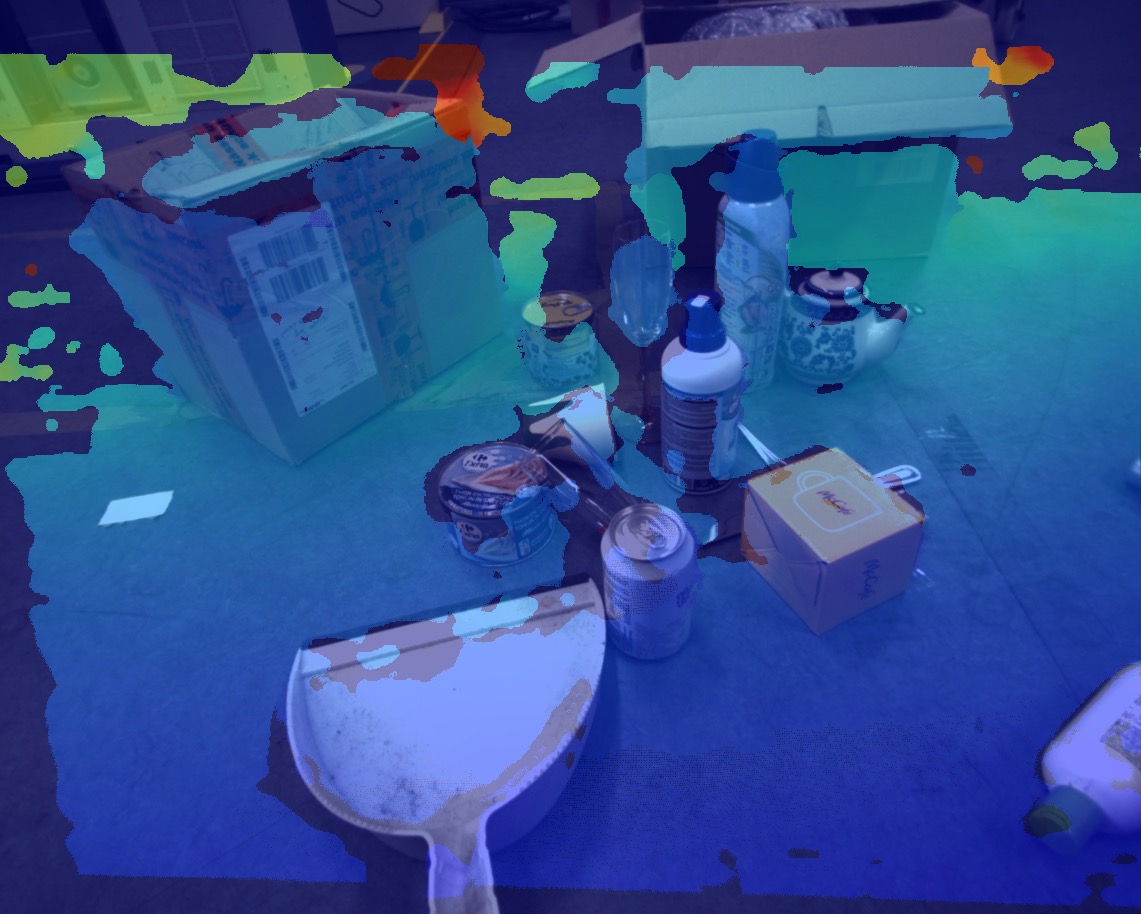
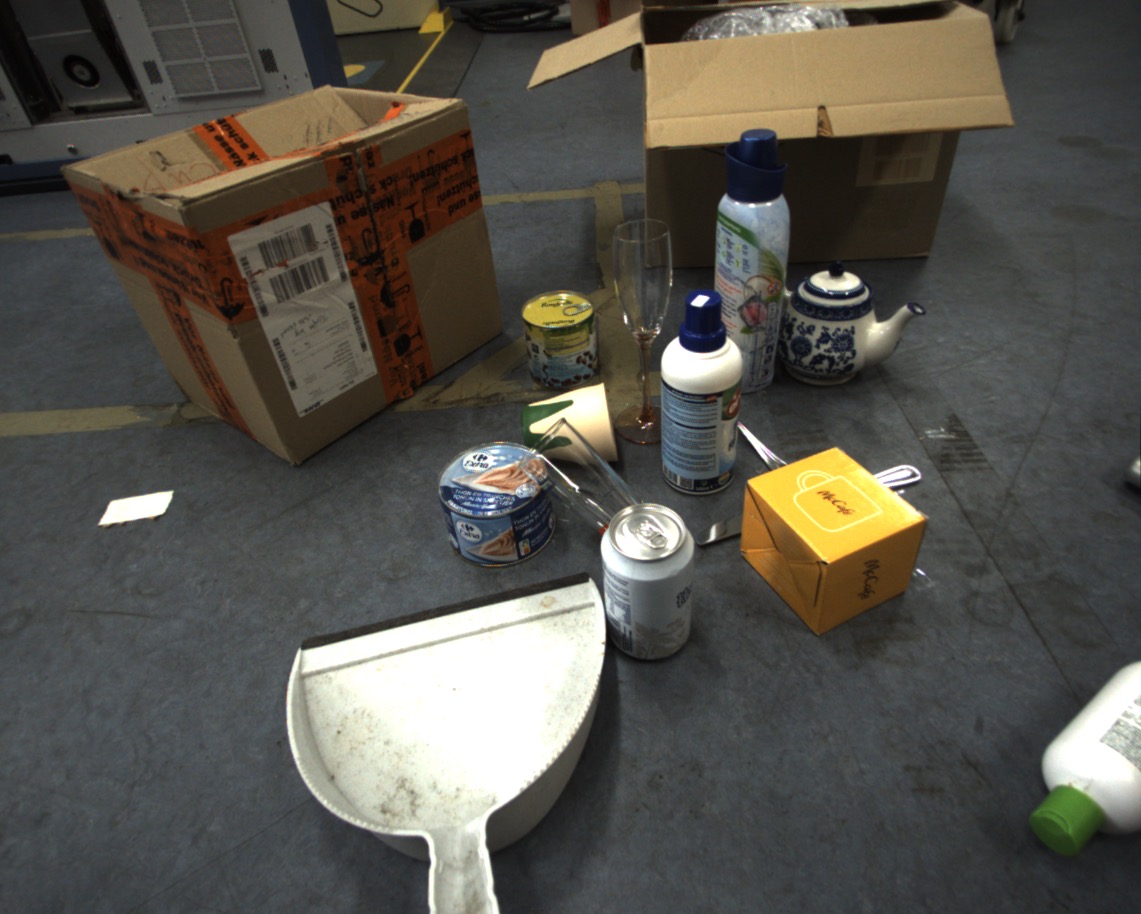
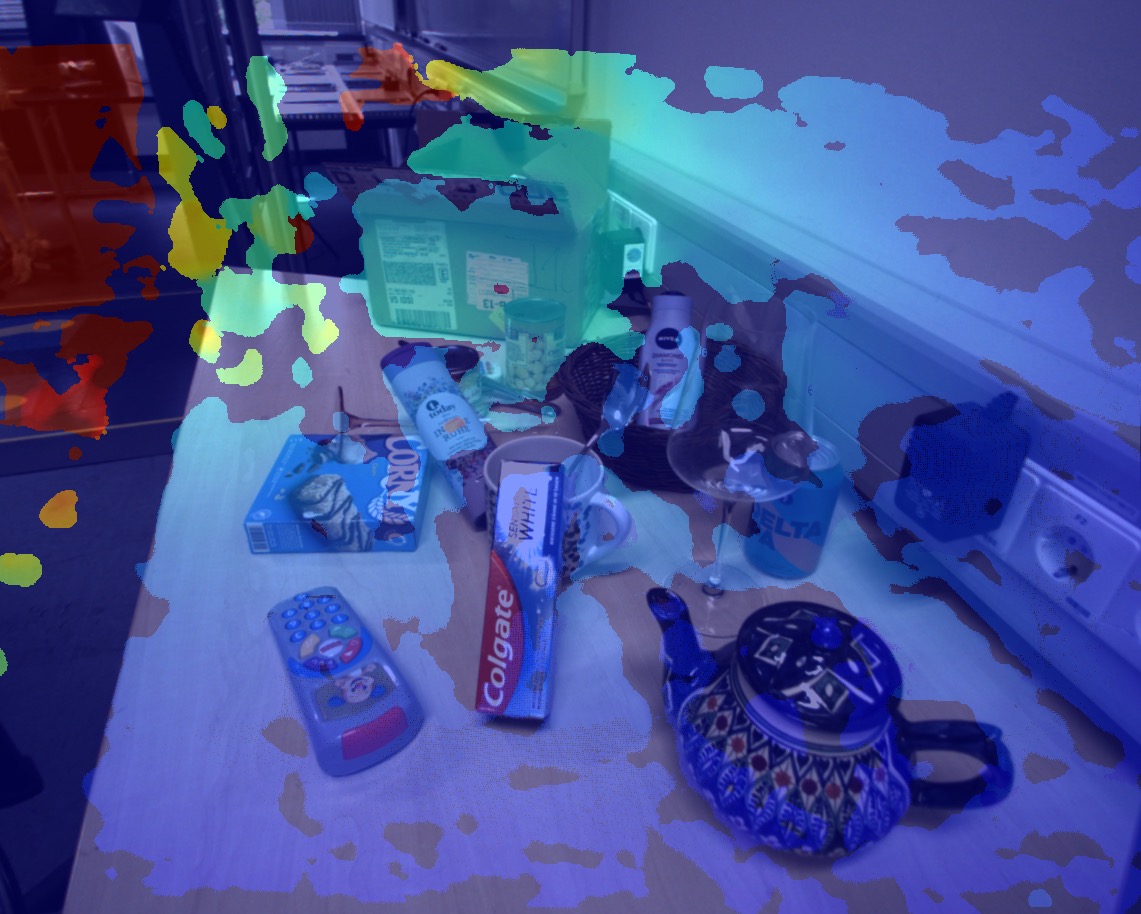
The TRICKY 2025 HouseCat6D Category-Level Object Pose Estimation Challenge addresses a persistent limitation of pose estimation: transparent and reflective surfaces distort visual observations and often produce noisy or missing depth measurements. Built on HouseCat6D, the challenge evaluates pose and scale estimation in realistic indoor scenes containing photometrically difficult objects. By focusing on glass and cutlery under occlusion, reflection and refraction, it encourages methods that generalize to challenging everyday environments.
Challenge dataset
A dedicated test set extends HouseCat6D with photometrically challenging objects and multimodal observations.
The challenge test set comprises glass and cutlery across three scenes. The paper describes RGB, depth and polarization observations. The 2025 competition has concluded; the challenge page retains its phases and results.
Evaluation
Predictions are evaluated using rotation and translation thresholds as well as 3D intersection-over-union (IoU). The challenge ranks methods by mean average precision (mAP) at 5° and 2 cm; ties are resolved using 10° and 2 cm, then IoU at 0.75. The evaluation follows the dataset's symmetry handling for applicable objects.
Challenge results
Mean results across the glass and cutlery categories from Table 1 of the paper. Values are percentages; higher is better.
| Method | 5° 2 cm | 5° 5 cm | 10° 2 cm | 10° 5 cm | IoU50 | IoU75 |
|---|---|---|---|---|---|---|
| DPDN | 0.39 | 0.65 | 1.18 | 3.32 | 93.95 | 69.89 |
| VI-Net | 0.48 | 1.03 | 2.43 | 5.93 | 24.23 | 3.46 |
| AG-Pose (DINO) | 1.89 | 2.73 | 6.57 | 11.78 | 96.41 | 77.89 |
| GCE-Pose | 3.36 | 4.64 | 8.32 | 14.60 | 96.09 | 83.78 |
| Enid (winning team) | 3.57 | 4.39 | 8.64 | 15.01 | 98.01 | 84.03 |
The leaderboard ranking uses 5° 2 cm. Missing predictions are scored as zero. See the paper for per-category results and method details.
Links
Explore the CodaLab challenge page, the evaluation repository, and the TRICKY workshop.
BibTeX
@InProceedings{Li_2025_ICCVW,
  title     = {TRICKY 2025 HouseCat6D Object Pose Estimation Challenge
               with Specular and Transparent Surfaces},
  author    = {Li, Weihang and Huang, Junwen and Jung, Hyunjun and Zhai, Guangyao and
               Zama Ramirez, Pierluigi and Costanzino, Alex and Tosi, Fabio and Poggi, Matteo and
               Di Stefano, Luigi and Weibel, Jean-Baptiste and Antensteiner, Doris and Vincze, Markus and
               He, Jing and Wang, Yiqing and Zhang, Kexin and Jiao, Licheng and Li, Lingling and
               Liu, Fang and Ma, Wenping and Busam, Benjamin},
  booktitle = {Proceedings of the IEEE/CVF International Conference on Computer Vision Workshops},
  year      = {2025},
  pages     = {3323--3333}
}